Master Velvety Crab Dip Recipe
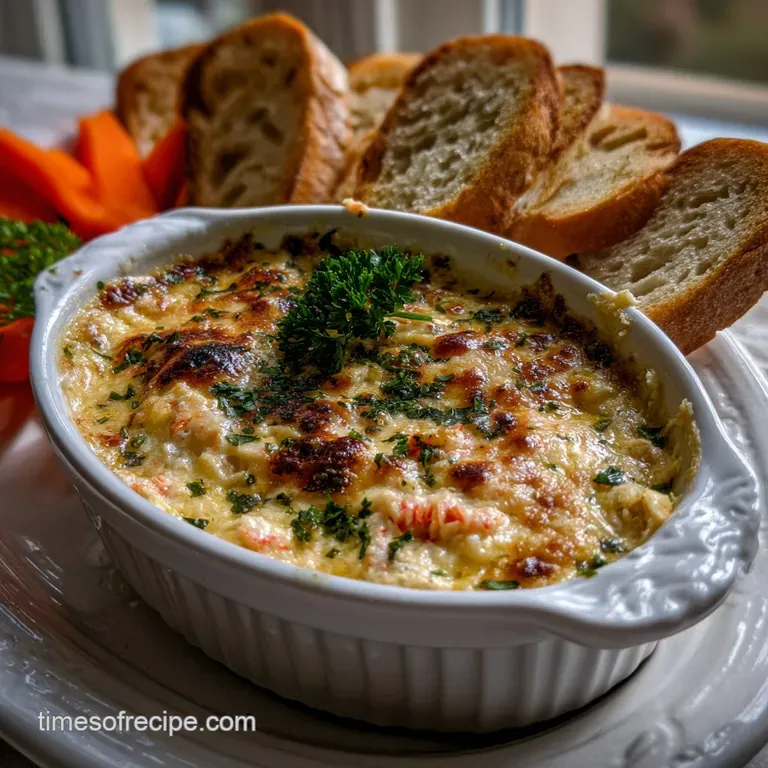
- Effort/Time: 35 minutes total (Moderate effort)
- Flavor Hook: Bold Old Bay spice met with sweet, jumbo lump seafood.
- Perfect for: Game-day gatherings, holiday starters, or a hearty family-style crowded table.
- The Molecular Harmony of Fats and Sweet Seafood
- Thermal Requirements and Precision Metrics for Success
- The Alchemy of Umami: Selecting Your Elements
- Essential Thermal Conductors and Preparation Tools
- The Multi-Stage Architecture of Flavor Development
- Navigating Structural Failures and Flavor Imbalances
- Creative Adaptations and Ingredient Exchange Protocols
- ⚗️ The Scaling Lab: The Physics of Quantity
- Common Myths
- Preserving Structural Integrity During Cooling and Re-Thermalization
- Optimizing the Sensory Experience for a Crowded Table
- Recipe FAQs
- 📝 Recipe Card
There is nothing quite as gut-wrenching as spending forty dollars on high-quality seafood only to pull a greasy, separated mess out of the oven. I once served a version where the oil from the mayonnaise pooled at the top, effectively "frying" the delicate crab into rubbery bits a total waste of premium ingredients and a hit to my hosting ego.
That failure taught me that a great crab dip recipe isn't just about mixing things in a bowl; it’s a lesson in moisture management and fat stabilization. A truly successful crab dip recipe must manage heat.
I used to think more cheese was always the answer, but I quickly realized that too much fat without enough structural "binders" leads to a broken sauce. I spent three football seasons tweaking ratios, oscillating between dips that were too stiff like a brick and those that turned into a soupy puddle.
It wasn't until I understood the role of sour cream as a pH balancer and cream cheese as a thermal stabilizer that the texture finally became what I call "velvety gold."
The scientific secret to this crab dip recipe lies in the emulsification of the base dairy. We aren't just heating cheese; we are creating a suspension where the water in the sour cream and lemon juice is trapped within the fat globules of the Philadelphia Cream Cheese and Hellmann’s Real Mayonnaise.
This prevents syneresis the fancy term for when your dip "weeps" liquid resulting in a consistent, shatter proof crumb and a rich, mahogany colored top. Understanding this core science ensures your crab dip recipe will be legendary.
The Molecular Harmony of Fats and Sweet Seafood
Emulsion Stability: The egg yolks in high-quality mayonnaise act as a bridge between oil and water, preventing the dip from breaking at high temperatures. This is crucial for any hot crab dip recipe.
Protein Integrity: Draining the crab meat prevents excess moisture from diluting the dairy base, ensuring the "jumbo" lumps remain distinct rather than disintegrating into the sauce.
Acidic Brightness: Fresh lemon juice and Worcestershire sauce provide a necessary "cut" through the heavy lipids, brightening the oceanic sweetness of the crab.
Maillard Interaction: Shredding your own cheddar cheese ensures better melting because pre-shredded bags are coated in potato starch, which inhibits a smooth, bubbly finish.
Thermal Requirements and Precision Metrics for Success
To achieve a satisfying result, we must respect the physics of heat. A standard ceramic baking dish provides even, slow heat distribution, which prevents the edges from scorching before the center reaches its target temperature.
| Metric | Target Value | Why It Matters |
|---|---|---|
| Oven Temperature | 175°C (350°F) | Optimal range for browning without breaking the fat emulsion. |
| Internal Temperature | 74°C (165°F) | Ensures the dairy is bubbling and safe while keeping crab tender. |
| Resting Time | 5 minutes | Allows the starches and proteins to set, preventing a "runny" texture. |
The Alchemy of Umami: Selecting Your Elements
Selecting ingredients for a crab dip recipe requires a focus on texture. Every element must serve a structural or flavor building purpose. For another hearty addition to your spread, you might Try This Hearty recipe which brings its own layer of comfort to a crowded table. Mastering this crab dip recipe is about controlling texture.
Ingredient Chemistry Breakdown
| Ingredient | Chemical/Physical Role (Science) | The Pro Secret (Why This Matters) |
|---|---|---|
| Cream Cheese | Casein protein network | Acts as the structural "glue" that prevents the dip from becoming soup. |
| Mayonnaise | Phospholipid emulsifier | Provides the "velvety" mouthfeel and carries oil-soluble spice flavors. |
| Old Bay Seasoning | Celery salt and paprika aromatics | The salt draws out moisture from the crab while the paprika aids in browning. |
| Lump Crab Meat | Myofibrillar protein structure | Large "lumps" provide a satisfying chew that contrasts the creamy base. |
- Substitute
- Neufchâtel (Will result in a slightly thinner, less rich consistency).
- 1/2 cup Hellmann’s Real Mayonnaise
- Why this? Contains stable egg emulsions that won't break at 175°C.
- Substitute
- Greek Yogurt (Warning: Adds significant tang and may curdle if heated too fast).
- 1/4 cup Sour Cream
- Why this? Adds lactic acid to balance the richness of the cheddar.
- Substitute
- Crème Fraîche (Results in a more buttery, less acidic finish).
- 1 cup Sharp Cheddar Cheese, divided
- Why this? Higher acidity in sharp cheddar improves the melt flow index.
- Substitute
- Monterey Jack (Provides a superior "cheese pull" but less bold flavor).
- Substitute
- Claw meat (Bolder "ocean" flavor but a shredded, less chunky texture).
- 2 tbsp Green Onions, finely sliced
- Adds a sulfurous bite to cut through the heavy cream.
- 1 tbsp Fresh Lemon Juice
- The citric acid tightens the protein structures in the crab.
- 1 tsp Worcestershire Sauce
- Adds "anchovy based" umami depth.
- 1 tsp Old Bay Seasoning
- The quintessential Maryland flavor profile.
- 1/2 tsp Dry Mustard Powder
- Acts as a secondary emulsifier to help the fats play nice.
- 1/2 tsp Garlic Powder
- Provides a baseline savory note without the moisture of fresh cloves.
- 1/4 tsp Cayenne Pepper
- Just enough heat to stimulate the palate.
Essential Thermal Conductors and Preparation Tools
- KitchenAid Hand Mixer
- Essential for aerating the cream cheese base for a lighter texture.
- Rubber Spatula
- Best for "folding" the crab to avoid breaking the expensive lumps.
- Microplane Grater
- If you choose to add fresh zest or use a block of cheese.
The Multi Stage Architecture of Flavor Development
Follow these steps with precision. The order of operations matters for the stability of the emulsion. Every step is vital to ensure this is the best crab dip recipe you’ve ever made.
- Preheat your oven to 175°C. Note: Critical for immediate Maillard reaction on the cheese topping.
- Beat the 8 oz cream cheese, 1/2 cup mayonnaise, and 1/4 cup sour cream together for 2 minutes until the mixture is completely smooth and no visible lumps remain.
- Incorporate the 1 tbsp lemon juice, 1 tsp Worcestershire, 1 tsp Old Bay, 1/2 tsp mustard, 1/2 tsp garlic powder, and 1/4 tsp cayenne. Note: Adding spices to the fat base first ensures even distribution throughout the crab dip recipe.
- Fold in 1/2 cup of the shredded cheddar and the 2 tbsp sliced green onions until just combined.
- Drain the 1 lb jumbo lump crab meat thoroughly in a fine mesh strainer until no liquid drips from the bottom.
- Gently mix the crab into the dairy base using a spatula until the meat is coated but the large lumps are still intact.
- Transfer the mixture into your baking dish, smoothing the top until it is level with the edges.
- Sprinkle the remaining 1/2 cup of cheddar over the surface. Note: This creates the "lid" that traps moisture inside the dip.
- Bake for 20 minutes until the edges are aggressively bubbling and the cheese on top has developed golden brown spots.
- Rest for 5 minutes until the bubbling subsides and the dip sets firm enough to hold its shape on a cracker.
Chef's Tip: For a truly unconventional texture, freeze your cheddar for 10 minutes before grating. This prevents the friction of the grater from warming the fat, resulting in "cleaner" shreds that melt into distinct, lacy patterns rather than a solid sheet.
Navigating Structural Failures and Flavor Imbalances
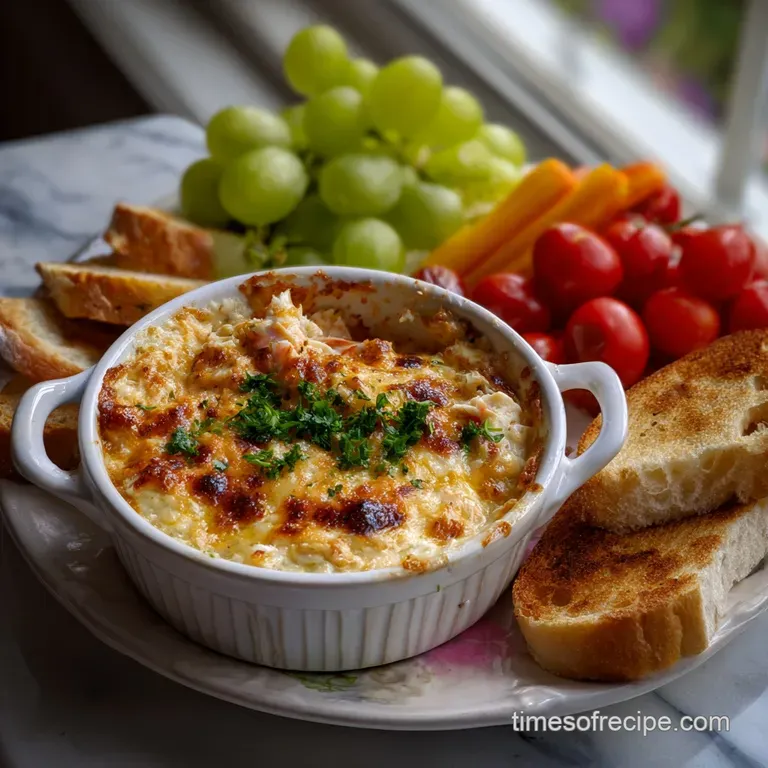
If things go wrong, it's usually a matter of temperature or moisture. This crab dip recipe is forgiving if you catch the error early. Developing a robust crab dip recipe means knowing how to troubleshoot.
Why is my dip watery?
When the dip becomes soupy, it’s usually due to "weeping" from the crab meat or the sour cream. If you didn't drain the crab properly, the excess brine will separate from the fat. If you're looking for a different festive treat that handles moisture differently, consider our Eggnog Recipe for your next gathering.
| Problem | Root Cause | The Fix | Pro Protocol |
|---|---|---|---|
| Oily Surface | Emulsion broke due to overheating. | Stir in 1 tbsp of warm sour cream gently. | Keep oven at 175°C; do not use broiler too early. |
| Rubbery Crab | Overcooked protein or poor quality meat. | Reduce cook time by 5 mins next time. | Use "Jumbo Lump" for heat resistance. |
| Bland Finish | Not enough acid to cut the lipids. | Add a squeeze of fresh lemon after baking. | Always use fresh lemon, never bottled. |
Creative Adaptations and Ingredient Exchange Protocols
Sometimes you want a "Maryland crab dip recipe" style (hot) or a "cold crab dip with dill" style for a summer picnic. Understanding how to swap ingredients without ruining the "hearty" nature of the dish is key. This adaptability makes the base crab dip recipe so versatile.
Decision Shortcut: If you want a shatteringly crisp top, mix 1/4 cup Panko breadcrumbs with melted butter and sprinkle over the cheese. If you want a low-carb version, serve with celery sticks and cucumber slices instead of bread.
If you want maximum umami, add 1 tsp of Old Bay Seasoning extra into the crust itself.
The Fresh vs. Shortcut Comparison
| Feature | Fresh Jumbo Lump | Canned/Shortcut Crab |
|---|---|---|
| Texture | Large, "shattering" bites of sweet meat. | Shredded, fibrous, and uniform. |
| Flavor | Delicate, sweet, and oceanic. | Salty, metallic, and pungent. |
| Cost | High ($30-$50 per lb). | Low ($10-$15 per lb). |
⚗️ The Scaling Lab: The Physics of Quantity
When you're preparing this for a truly crowded table and need to double the batch, the rules of physics change. Doubling this crab dip recipe requires scaling the physics as well as the ingredients.
- The Evaporation Paradox: If you double the recipe in the same size pot, the volume increases but the surface area doesn't. Your dip will stay watery. Solution: Use two separate baking dishes rather than one deep one to ensure the "liquid-to-surface" ratio remains constant.
- Flavor Saturation: Do not double the Old Bay or Cayenne. Scale the spices to 1.5x first. Spices accumulate non-linearly in fat-heavy bases; you can always sprinkle more on top, but you can't take it out.
- Thermal Mass: A double batch in a single deep dish will take nearly 45 minutes to reach the core temperature of 74°C, by which point the edges will be scorched and the crab rubbery. Stick to multiple small dishes.
Common Myths
Myth: You must use fresh caught crab for a good dip. Truth: high-quality pasteurized "Jumbo Lump" found in the refrigerated seafood section is often better because it’s pre-cleaned and consistently sweet.
Myth: The "crab dip recipe" will be better if you mix it a day in advance. Truth: While the flavors meld, the lemon juice can begin to "cook" (denature) the crab meat via acid, making it slightly mushy. Mix the base ahead, but fold the crab in just before baking.
Preserving Structural Integrity During Cooling and Re-Thermalization
Storage: Store leftovers in an airtight container for up to 3 days in the fridge. The high fat content acts as a preservative, but the crab will eventually lose its sweetness.
Freezing: I do not recommend freezing this crab dip recipe. The emulsion of the mayonnaise and sour cream will break upon thawing, resulting in a grainy, watery mess that no amount of stirring can fix.
Reheating:Oven: The best method. Cover with foil and heat at 150°C for 15 minutes. Microwave: Only in 30 second bursts at 50% power to prevent the oil from separating.
💡 ZERO WASTE PHILOSOPHY: Don't discard the green onion roots or the lemon peels! Green Onion Roots: Place them in a jar of water on your windowsill; they will regrow in a week.
Lemon Peels: Zest them into a small bowl of salt to create a "citrus finishing salt" for your next seafood dish. Science: The oils in the peel are highly aromatic and stabilize the salt’s flavor.
Optimizing the Sensory Experience for a Crowded Table
The way you serve a hot crab dip recipe determines the "comfort" factor. I love serving this in a warm Lodge Cast Iron Skillet placed on a wooden board right in the middle of the table.
- Contrast Points: Serve with toasted baguette slices (the "crunch") and chilled cucumber rounds (the "cool").
- Visual Appeal: A final dusting of Old Bay and a handful of fresh green onions adds a pop of color against the mahogany cheese.
- The "Cold" Variation: If you prefer a cold crab dip recipe, omit the cheddar topping and the baking step. Then, let the mixture chill for 2 hours. The "cold crab dip with dill" profile is much more refreshing for summer.
Whether you're making a classic Maryland version or a "cold crab dip with dill", the goal is a satisfying, bold experience that brings people together. Trust the science of the emulsion, don't over handle the crab, and you'll have a result that is velvety, hearty, and gone in seconds.
Now, let's get that oven preheated for your perfected crab dip recipe.

Recipe FAQs
Can I substitute mayonnaise with Greek yogurt?
No, Greek yogurt results in a tangier, thinner dip. Egg yolks in mayonnaise create a vital, stable phospholipid emulsion, crucial for surviving the heat without breaking. Using yogurt adds unwanted moisture and acidity that destabilizes the fat barrier.
What is the key to preventing the dip from becoming oily?
Use cream cheese as the primary thermal stabilizer. The casein proteins in cream cheese form a cohesive network that traps the lipids from the mayonnaise and cheddar during heating. Overheating or adding liquids too fast breaks this structure, causing the oil to separate.
- Ensure cream cheese is fully softened
- Stir in spices before adding wet ingredients
- Keep the oven temperature strictly at 175°C
Is it better to use block cheddar or pre-shredded cheese?
Block cheddar melts smoother for a superior crust. Pre-shredded cheeses are coated in anti caking agents like cellulose, which inhibit full melt and can create a slightly gritty topping. If you master the emulsification base here, the quality of your final cheese addition matters greatly for texture.
What internal temperature must the dip reach?
74°C (165°F) is the required internal temperature. This guarantees the dairy base is safely heated through and actively bubbling without overcooking the delicate crab meat protein structure.
Should I mix the entire dip base the day before baking?
Myth: Combining everything 24 hours ahead enhances flavor. Reality: The acid from the lemon juice will begin to chemically "cook" (denature) the crab meat, leading to a slightly mushy texture when baked. Mix the base, but fold in the crab within one hour of baking.
Can I freeze leftover crab dip?
No, freezing destroys the emulsion. The water and fat components of the mayonnaise and sour cream matrix will separate irreversibly upon thawing, resulting in a grainy, watery texture that cannot be salvaged by reheating.
What is the difference between using clarified butter versus whole butter?
Clarified butter offers cleaner flavor and higher heat tolerance. Whole butter contains milk solids and water, which lower the smoke point and can cause scorching during the baking phase. If you enjoyed learning the science of fat stability here, you will appreciate how the same principle applies to making rich French sauces, like those used in our Escargot: Classic French Snails in Garlic Herb Butter Recipe.
Master Crab Dip Recipe
Ingredients:
Instructions:
Nutrition Facts:
| Calories | 252 kcal |
|---|---|
| Protein | 12.5 g |
| Fat | 21.7 g |
| Carbs | 1.4 g |
| Fiber | 0.1 g |
| Sugar | 0.8 g |
| Sodium | 291 mg |
