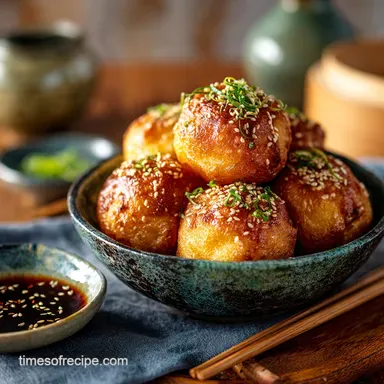
Crispy Japanese Curry Bread

- Total5 Hrs 20 Mins
- Servings8 buns
- Calories588 kcal
- Time: 55 min active + 25 min cooking + 4 h resting
- Skill level: Intermediate, as it requires dough kneading and tight sealing to prevent leaks
- Great for: Savory afternoon snacks or hearty party appetizers
Imagine a rainy afternoon where you want something that feels like a warm hug. You hear the loud, satisfying crack of a golden crust, then hit a pillowy layer of bread, and finally reach a rich, savory beef curry center. It's the kind of comfort food that feels special but is grounded in simple, bold flavors.
This treat is all about contrasts. You get the bright crunch of toasted breadcrumbs against the deep, earthy notes of Japanese curry. It's a satisfying balance that makes it a standout choice for a weekend project.
You can expect a process that involves a bit of patience while the dough rises, but the result is a professional-style snack. This Japanese curry bread brings together a soft enriched dough and a concentrated filling that stays put during frying.
Japanese Curry Bread
The trick to the texture is the flour blend. Combining bread flour for structure with cake flour for tenderness helps keep the buns from feeling too dense or bread-like.
Another key is the temperature gap. Using a filling chilled to 40°F keeps the curry from softening the dough while you seal the buns, which helps the closure stay clean and sealed.
Recipe Specs
This recipe yields 8 buns. The total time is 5 hours 20 minutes, which includes the essential resting and rising phases.
The internal temperature of the ground beef must reach 160°F (71°C) during the initial sauté to be safe. The frying oil should be held strictly between 340°F and 350°F (170°C-180°C) to ensure the Panko browns without burning the dough.
Ingredients and Swaps
The filling needs to be a thick paste, not a stew. The Japanese curry roux provides the base thickness, while honey adds a hint of sweetness to balance the savory beef.
For the dough, warm milk keeps the yeast active and contributes to a soft crumb. Panko is used instead of standard breadcrumbs because its larger flakes create a more airy, jagged crunch.
Filling
- 1 lb (450g) ground beef Why this? Provides a hearty, savory base
- 1 medium (150g) onion, finely diced
- 1 large (150g) carrot, finely diced
- 1 small (100g) potato, finely diced
- 3 tbsp (45g) Japanese curry roux Why this? Essential for the signature flavor and thickness
- 1 cup (240ml) beef stock
- 1 tbsp (15g) unsalted butter
- 1 tsp (5g) honey
- 1/2 tsp (3g) salt
Dough
- 2 cups (250g) bread flour Why this? Gives the bread its necessary chew
- 1/2 cup (60g) cake flour Why this? Softens the overall texture
- 2 tbsp (25g) granulated sugar
- 1 tsp (3g) instant yeast
- 1 tsp (5g) fine salt
- 1/2 cup (120ml) warm milk (110°F/43°C)
- 1 large (50g) egg, room temperature
- 3 tbsp (42g) unsalted butter, softened
Coating and Frying
- 1/2 cup (120ml) beaten egg
- 1 cup (100g) Panko breadcrumbs Why this? Creates a lighter, crispier crust
- 1 quart (950ml) neutral oil for frying
| Original Ingredient | Substitute | Why It Works |
|---|---|---|
| Ground Beef | Ground Turkey | Leaner option. Note: May need an extra pinch of salt, and cook the filling to 165°F (74°C) instead of 160°F |
| Beef Stock | Vegetable Stock | Similar liquid profile. Note: Lacks the deep beefiness |
| Cake Flour | All-Purpose Flour | Similar role. Note: Buns will be slightly chewier |
What You'll Use
A stand mixer is helpful for the long kneading process, though you can do it by hand. A digital thermometer is a requirement for checking the beef and the oil temperature.
You will also need a shallow container for chilling the filling and a wire rack for draining the buns after they come out of the oil.
Key Steps
Prepare the Concentrated Filling
Sauté 1 tbsp (15g) unsalted butter and 1 medium (150g) finely diced onion in a pan until translucent. Add 1 lb (450g) ground beef and cook until browned and it reaches an internal temperature of 160°F (71°C). For more details on safe temperatures, see these USDA food safety guidelines.
Stir in 1 large (150g) finely diced carrot and 1 small (100g) finely diced potato. Pour in 1 cup (240ml) beef stock and simmer until vegetables are tender.
Stir in 3 tbsp (45g) Japanese curry roux, 1 tsp (5g) honey, and 1/2 tsp (3g) salt. Stir until the mixture thickens into a heavy paste. Transfer the mixture to a shallow container and refrigerate until the filling is below 40°F (4°C).

Develop the Dough
In a stand mixer or large bowl, combine 2 cups (250g) bread flour, 1/2 cup (60g) cake flour, 2 tbsp (25g) granulated sugar, 1 tsp (3g) instant yeast, and 1 tsp (5g) fine salt. Add 1/2 cup (120ml) warm milk and 1 large (50g) egg.
Knead for 10-12 minutes with a mixer or 15-20 minutes by hand. Incorporate 3 tbsp (42g) softened unsalted butter and continue kneading until the dough passes the windowpane test.
Note: You should be able to stretch a small piece of dough into a thin, translucent membrane without it tearing.

First Rise and Portioning
Place dough in a greased bowl and cover. Let rise in a warm spot for 60-90 minutes until doubled in size.
Punch down the dough and divide into 8 equal pieces (approximately 2 oz/60g each). Roll into balls and let rest for 15 minutes.
Fill and Seal
Flatten a dough ball into a circle. Place 1½ tbsp of the chilled curry filling in the center. Pinch the edges tightly to seal into a ball. Repeat for all 8 pieces.
Let the shaped buns rise for 30 minutes until they look plump.

The Golden Fry
Heat 1 quart (950ml) neutral oil to 340°F-350°F (170°C-180°C). Dip each bun in 1/2 cup (120ml) beaten egg, then roll in 1 cup (100g) Panko breadcrumbs, pressing gently to adhere.
Fry the buns in batches for 3-5 minutes, turning occasionally, until a chestnut brown crust forms. Drain on a wire rack.

How to Fix Common Problems
If your buns leak during frying, it usually means the filling was too warm or the seal wasn't tight enough. Warm curry softens the dough and creates steam pockets that burst through the sides.
When the Panko browns too quickly, the oil temperature is likely too high. This leaves the center of the dough undercooked while the outside looks burnt.
Dealing with Leakage
Use your thumb and forefinger to twist the dough seal shut, similar to how you would close a dumpling. This creates a tighter bond than just pinching.
Managing Dough Stickiness
If the dough stays sticky after adding butter, resist the urge to dump in more flour. Keep kneading, as the butter needs a few minutes to spread evenly through the dough.
| Problem | Fix |
|---|---|
| Filling leaks during frying | Chill filling below 40°F and twist the seal tightly |
| Panko burns too quickly | Lower oil temp to 340°F and fry in smaller batches |
| Dough doesn't rise | Check yeast freshness and ensure milk is exactly 110°F |
| Buns feel greasy | Ensure oil is at least 340°F before adding buns |
Make It Your Own
For a different flavor profile, try adding 1 tbsp of grated parmesan cheese to the curry filling for a saltier, richer core. You can also add finely chopped pickled ginger to the beef for a bright, acidic contrast.
If you prefer other types of enriched breads, you might enjoy a Sourdough Discard Cinnamon Bread recipe for a sweet morning alternative.
For those who want to avoid deep frying, you can brush the buns with melted butter and bake them at 375°F (190°C) for 15-20 minutes. The texture will be more like a traditional roll than a street snack, but the flavor remains the same.
Make-ahead and Leftover Tips
Prepare the curry filling a day ahead and refrigerate it. This allows the spices to meld, which actually improves the flavor.
Keep any remaining Japanese curry bread in a sealed container in the refrigerator for up to 3 to 4 days (USDA FSIS).
Skip the microwave to avoid soggy bread; instead, maintain the crunch by using an air fryer at 350°F (175°C) for 3-5 minutes, or a toaster oven until the crust sizzles, heating until the center reaches 165°F (74°C). To reheat on the stove, use a clean pan over medium heat with a small pat of butter.
Heat until the center reaches 165°F (74°C) (USDA FSIS).
Fully cooked and cooled buns can be frozen for up to 1 month. Let them defrost in the refrigerator overnight before warming them in the oven or air fryer.
Serving Suggestions

While these buns are filling enough to stand alone as a meal, pairing them with a fresh side salad helps balance the richness. A traditional option is a light cabbage slaw tossed in rice vinegar.
To drink, either a warm green tea or a refreshing iced tea complements the intense curry flavors. Enjoy these while warm to fully appreciate the delicious contrast of the piping hot center and the crunchy exterior.
Common Questions
Which ingredients are in the curry filling?
This filling uses ground beef, onion, carrot, potato, Japanese curry roux, beef stock, honey, and salt.
Tip: Chill the mixture to 40°F before filling to ensure the dough seals properly.
Is the calorie count high for these buns?
Each bun contains 588 kcal.
Tip: Drain the buns on a wire rack immediately after frying to remove excess oil.
Why is the dough sticky after adding butter?
Butter coats the gluten strands, which temporarily creates a slippery, sticky consistency during the mixing process.
Tip: Keep kneading until the dough becomes smooth and passes the windowpane test.
How to fix dough that is too dry?
Add warm milk one teaspoon at a time until all the flour is fully incorporated.
Tip: Mix on low speed to avoid overworking the dough when adding extra liquid.
Can ground turkey be used instead of beef?
Yes, ground turkey is a viable leaner alternative to beef for the filling.
Tip: Monitor the cooking time closely as turkey can dry out faster than beef. Cook ground turkey or chicken to an internal temperature of 165°F (74°C).
What makes this bread texture different?
A combination of bread flour for structure and cake flour for tenderness creates a softer crumb than standard bread.
Tip: Do not skip the 30-minute final rise to ensure the buns are plump before frying.
Crispy Japanese Curry Bread
Ingredients:
Instructions:
Try These Next

Filipino Recipe Pandesal: Classic Filipino Bread Rolls
Master the authentic pandesal recipe with our guide to classic Filipino pandesal.

Sourdough Discard Cinnamon Bread Baked
Master our sourdough discard cinnamon bread recipe. With a step-by-step timing guide, this sweet…

Sugar Free Banana Bread with Applesauce
Discover the best Sugar Free Banana Bread recipe using natural fruit sweetness.

Homemade Apple Bread with Shredded Apple: Oven-Only
Make Homemade Apple Bread with Shredded Apple using our step-by-step guide.
